Historic tours show city from a fresh perspective
Community Development shares early plans for an interactive map highlighting Fort Wayne's historic structures.
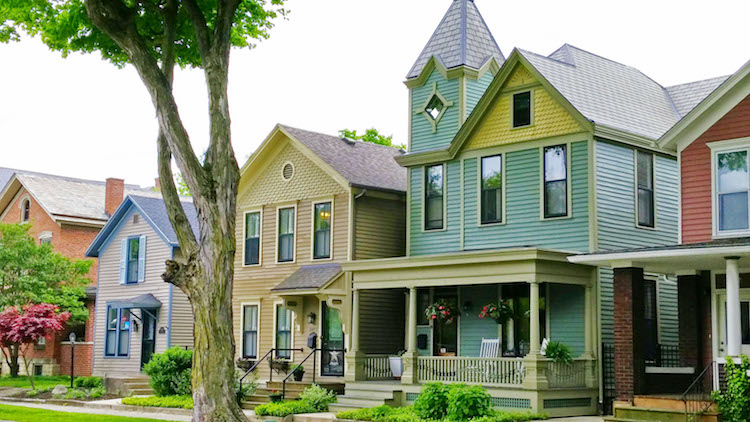
Northeast Indiana may not have the oceans or the mountains, but it does have historic buildings and neighborhoods. And while residents might not consider these amenities potential forms of recreation, they might soon have reason to give their hometown a second look.
Mary Tyndall and Don Orban of the City of Fort Wayne’s Community Development office have put together a series of brochures on the city’s historic districts, detailing the styles and time periods of each structure.
With plans to finish compiling the information this fall, they would like to eventually turn their data into an interactive map that would allow residents to take self-guided walking tours of historic areas.
“We’re actually looking at one of the maps in New York as a reference,” Orban says.
While he warns that the project is in its early phases, he’s looking into what it would take to create something similar to a map recently developed by the NYC Landmarks Preservation Commission.
“It offers a short description, as well as the name and style of significant structures,” Orban says. “We have a lot of that information already.”
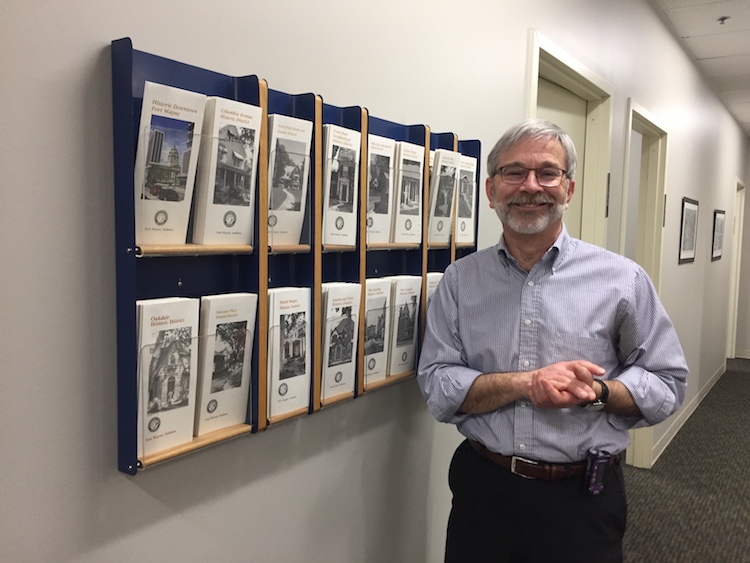
As a Planner on the City of Fort Wayne’s Historic Preservation Commission, Orban sees local interest in historic homes and structures on a daily basis.
He spends most of his days working with homeowners in Fort Wayne’s historic districts, helping them maintain their properties’ value and often fielding questions about what their homes once looked like.
His work begs the question of what qualifies as “historic” in the first place.
First, Orban says it’s important to distinguish between national historic districts and local historic districts, which have similar qualifications, but different rules.
While a national historic district identifies an area as historically significant, a local historic district protects the area from changes that might compromise its value or integrity.
Fort Wayne has 16 national historic districts, but it only has 5 local historic districts concentrated downtown and in near-downtown neighborhoods, including the Columbia Avenue, The Landing, West Central, Williams Woodland Park, and Shawnee Place. it also has standalone historic structures that have their own designations.
As a Planner, Orban says he’s not into hammering home the code to residents in historic districts, dictating what paint colors they can use on their houses or how to do their landscaping. It’s more about structural changes to the property, like adding sheds or garages.
But while residents in historic districts don’t have to get his approval for everything, many homeowners do choose to stop in to ask him about things like paint colors simply because they want their space to feel authentic.
In order to qualify for a historic district, at least 50-60 percent of residents in an area have to agree to it, Orban says.
“Another one of the main qualifications is it needs to be at least 50 years old or it can be built by a master,” he explains.
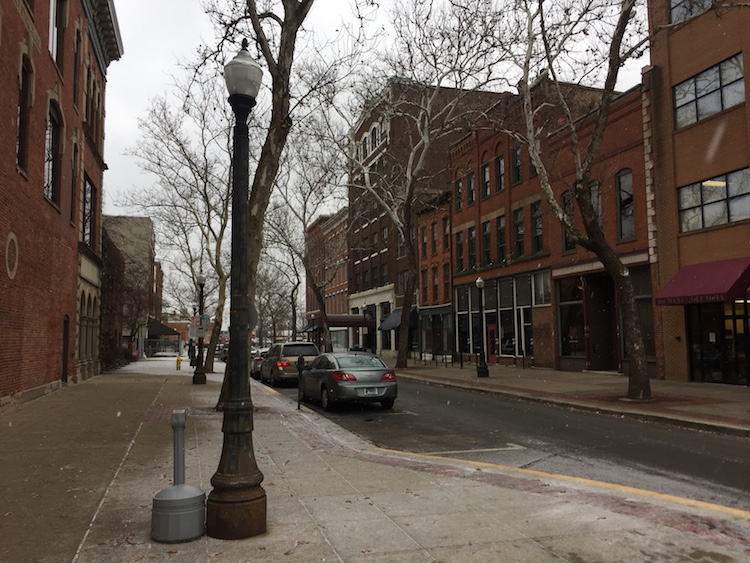
When considering whether a historical designation is right for a district or a structure, two questions he often asks is: If the person who built the structure came back to it today, would they recognize it? And are there any special events or people that made the structures significant?
For instance, while the Arts United Center downtown is not yet 50 years old, it was designed by the master architect Louis Kahn, so that qualifies it as a historical, protected structure instead of its age.
“It’s Kahn’s only theatre, and it’s his only project in the Midwest.” Don says.
Along with the Arts United Center, several other buildings in the downtown area have a historical designation for similar reasons: the integrity of their structures or the significance of their architects.
While downtown itself is not a historic district, it’s the oldest part of the city, Orban says, specifically on The Landing, where the Erie Canal once ran through.
He explains that there were buildings there dating back to the 1830s and 40s on The Landing, and while many of these were replaced when the Canal was replaced by the railroads, even the structures from those times are still some of the oldest left today.
If Orban and Tyndall do make an interactive map featuring Fort Wayne’s historical districts, they plan to start with historic sites downtown first.
“That would be an easy one to start with,” Tyndall says.
She explains that Visit Fort Wayne and Community Development already have free brochures she and Orban put together for each historic district in the city. But having a newly designed map would make this information more readily accessible to residents, as well as visitors.
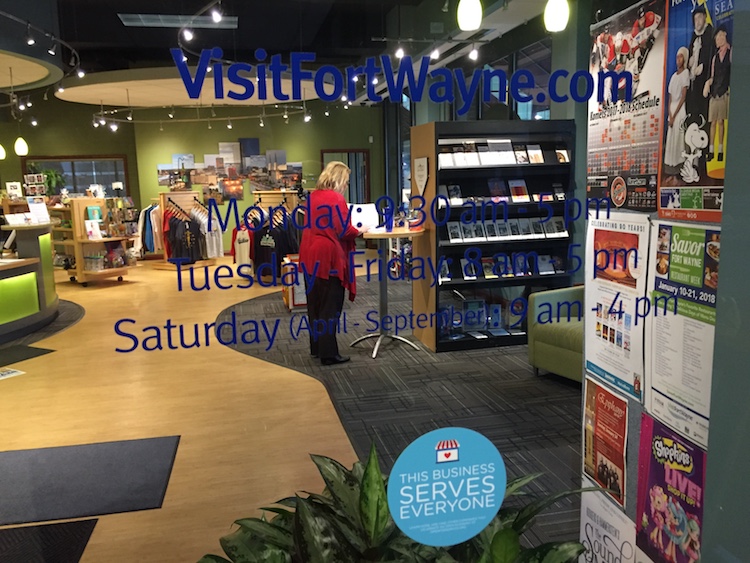
Organizations like ARCH used to offer walking tours on a regular basis, Tyndall says, and while they still do tours occasionally, a resource residents could access on their phones would give them the ability to take tours at their leisure.
And lest you think living or working in downtown Fort Wayne would make a tour boring for you, Tyndall says think again.
In the process of putting the brochures together with Orban, she admits that she’s learned quite a bit about the city’s architecture herself, and it’s helped her see her hometown from a new perspective.
“We would be walking around, and Don would point to a building, and say, ‘Look at that gargoyle there,'” Tyndall says. “He points out things I never would have known to look for.”
Take the former Somewear on Main storefront in the Freistroffer Block building at 207 W Main St., for example.
Many downtown drivers have probably seen the shop on their way to Coney Island or the Yummi Bunni, and with its decorative exterior and striped awnings, it looks like it was made to be a boutique.
“It was actually a blacksmith shop,” Orban says. “If you look up, you can see the date, and small horseshoes that indicate what it is.”
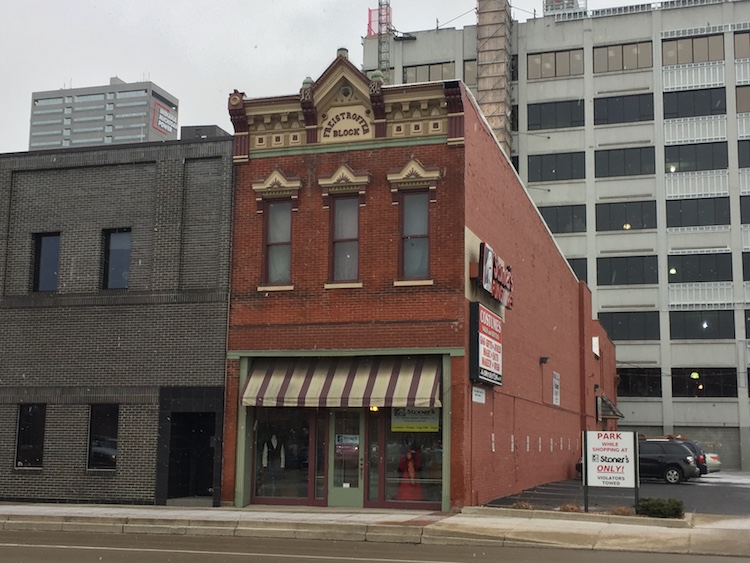
“That’s what Don always says is, ‘Look up!’” Tyndall adds.
“You’re used to walking by these buildings, and after awhile, they’re just there,” Orban continues. “This may get people to look at things a little differently.”
According to Tyndall and Orban, one of the areas in Fort Wayne that’s getting a second look from residents is the West Central Historic District.
“It’s become an extremely hot neighborhood,” Tyndall says.
She notes that the West Central walking tour brochures are the first ones visitors most often pick up at Visit Fort Wayne, and while part of the reason is the neighborhood’s proximity to downtown, another part is its architectural variety.
Don says the neighborhood offers a range of houses in many styles and ages, from the 1850s all the way up to the 1950s.
“That’s the only neighborhood you’re going to find that in,” Orban said. “It’s because people started with a small house, and then as they acquired wealth, they built bigger homes in the area.”
If you would like to experience Orban’s historic tour today, you can pick up a self-guided brochure in the Community Development office at Citizen’s Square, in Visit Fort Wayne, or on Community Development’s website.
Orban hopes residents continue to rediscover the significant architecture around them every day because, ultimately, that is what gives Fort Wayne its character.
“People complain we don’t have the mountains or the oceans. But we do have unique architecture,” Orban says. “These things make us special.”
Author

Related Articles
Help shape future coverage – join our upcoming listening session
Join Input Fort Wayne at Tall Rabbit for coffee, conversation, and a chance to share the issues, people, and neighborhood stories you think deserve more attention.
Partner Partner Content Bringing neighbors together: Q&A with Réna Bradley on the Inspire Neighborhoods Conference
Neighborhood Planner Réna Bradley explains how the Inspire Conference supports local change-makers by connecting residents and sharing tools for building resilience.
How public art is showing up in Fort Wayne’s neighborhoods
Neighborhood leaders say art installations help evoke and maintain a sense of place, identity, and pride.